
Ethical Intelligence Insights
How Recursive Judgment Science Improves Executive Decisions
An introduction to Dr. D. Ivan Young’s Recursive Judgment Science™ framework and its practical closed-loop architecture for executive decisions.
Last updated:
By Dr. D. Ivan Young · For Executives, boards, governance professionals, and leaders responsible for high-consequence decisions
How does recursive judgment science improve executive decision making? The answer begins not with information gaps but with architecture. Executives sometimes fail not for lack of information but because feedback loops in their decision systems can reinforce distortions, and by the time a decision surfaces for review, that distortion has cycled through multiple rounds, each one compounding the last. The output feels like leadership. The mechanism is something closer to compounding error.
Recursive Judgment Science™ is Dr. D. Ivan Young’s founder-developed framework for making that internal system visible and open to examination. It is the methodological foundation behind the work of Young Ethical Intelligence and the architecture driving the URIEL platform. How recursive judgment science improves executive decision making is not a philosophical question. It is an architectural one, and that architecture can be mapped, measured, and deliberately improved.
This article covers the mechanics of the closed-loop model at the center of every executive decision, where the loop breaks down under pressure, what intervention looks like at each node, and what it takes to build a recursive decision architecture that your organization can actually measure.
How Recursive Judgment Science Improves Executive Decision Making: The Closed-Loop Architecture
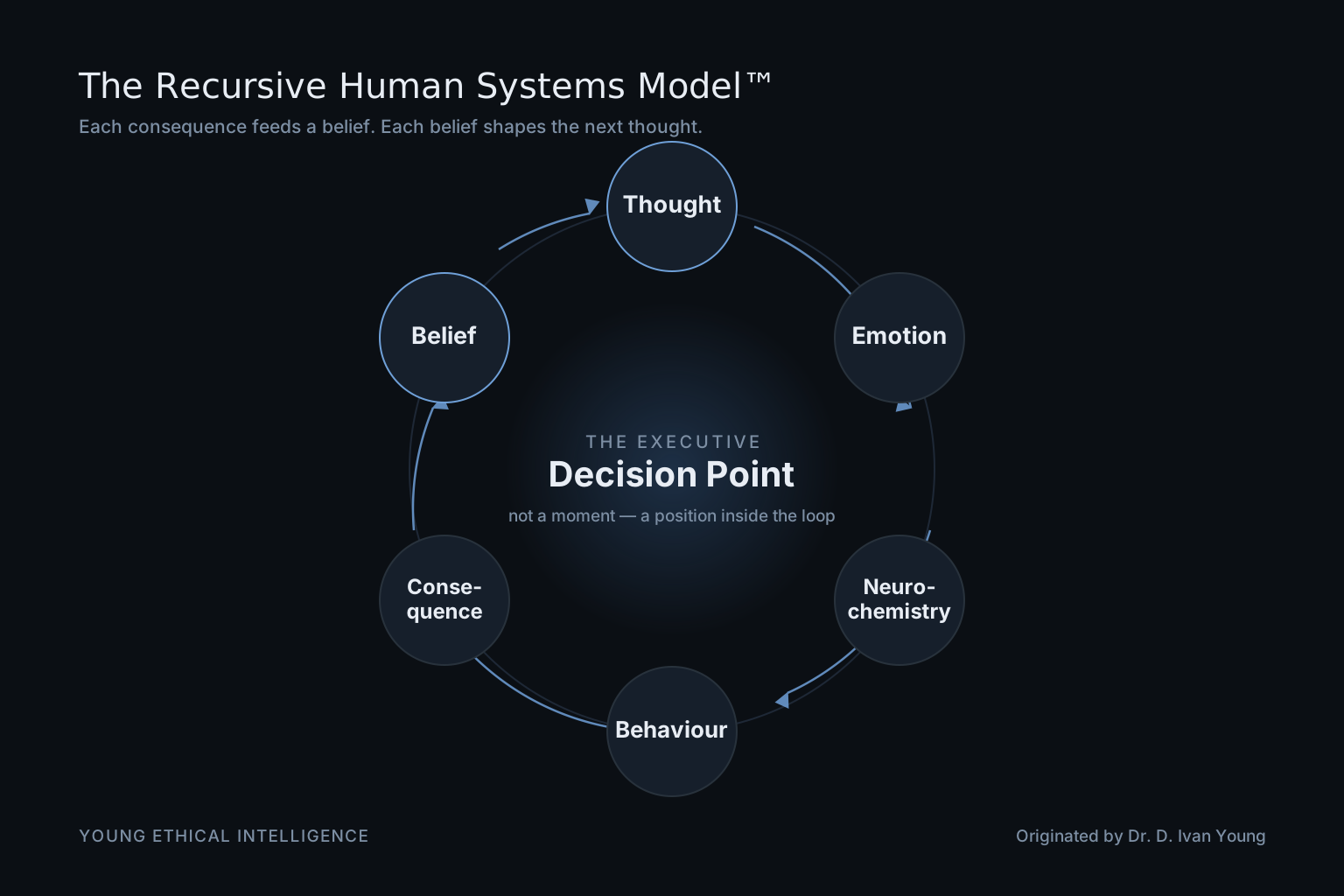
The Recursive Human Systems Model™ is not a metaphor for how decisions feel. It is a proposed functional map, grounded in neuroscience and behavioral research, of how judgment is produced in the human brain under institutional pressure. The model identifies six nodes operating as a closed loop: Thought, Emotion, Neurochemistry, Behavior, Consequence, and Belief. Each node feeds the next, and the final node, Belief, rewires the input that started the cycle. That means the loop is always running whether you are managing it or not.
The sequence works like this. A Thought activates an Emotion. That Emotion triggers a Neurochemical state, which shapes what Behavior the executive expresses. The Behavior produces a Consequence. The Consequence updates a Belief, and that Belief shapes the next Thought entering the system. While the relationships between these nodes are well-supported by research on emotion, prefrontal cortex function, and belief updating, the chain is best understood as a conceptual framework for decision architecture rather than a rigid stepwise mechanism. It is a continuous, self-referencing process that most executive decision frameworks treat as if it were a one-shot choice.
This matters because most decision tools intervene at the wrong node. They surface better information or add approval steps at the Behavior level, while the Belief and Thought nodes, where recursive distortion originates, remain entirely unexamined. The loop is always cycling. Recursive Judgment Science™ makes the cycle legible so it can be improved deliberately rather than inherited by default.
Where the Loop Breaks Down Under Pressure
The Neurochemical node represents one of the highest-risk failure points in the system. Under acute or chronic stress, cortisol and threat activation can impair prefrontal cortex function, the biological seat of deliberate evaluation, working memory, and cognitive reappraisal. Peer-reviewed neuroscience is consistent here: chronic stress produces structural and functional changes to the prefrontal cortex, including reduced volume and lower executive control capacity. When this node distorts, every downstream output flows from a compromised signal, but the executive experiences the decision as normal judgment.
When executive functions are stress-impaired, they reduce iterative updating and push decision-making toward habitual, reactive responding rather than metacognitive revision. Working memory capacity acts as a partial buffer: individuals with higher working memory show less stress-related decline in their ability to revise prior judgments, while those with lower capacity show larger impairment. Research on stress and executive function suggests that sustained pressure can reduce cognitive flexibility and make iterative judgment more difficult, including in senior leadership contexts. This is the neurophysiological basis for one of the most persistent gaps in conventional leadership development.
The Belief node presents a different kind of risk. Once a Consequence reinforces a distorted Belief, the next cycle of Thought inherits that corruption. The longer the loop runs unchecked, the more a wrong Belief feels like earned wisdom. This is what cognitive atrophy looks like from the inside: the conviction is intact, the reasoning feels sound, and the distortion has been running for years. Belief-level intervention is under-emphasized in most conventional leadership programs, which makes it among the most strategically valuable entry points in the entire architecture.
Intervening at Each Node to Sharpen Decision Quality
Upstream interventions begin at the Thought level with decision classification. Classify the decision by stakes and reversibility before any analysis begins. This step alone slows premature closure and forces the executive to name what kind of decision they are making before the emotional state sets in. A reversible, low-stakes choice does not deserve the cognitive load of an irreversible, high-consequence one. Conflating the two is a structural error that wastes deliberative capacity on routine choices and underinvests it in critical ones, a distinction well-supported by research on decision types and cognitive load management.
Emotion-level interventions use cognitive reappraisal techniques grounded in executive function research. The mechanism is straightforward: reframing the stressor's meaning before it activates a neurochemical cascade that narrows available options. Studies on cognitive reappraisal consistently show it reduces emotional interference while preserving prefrontal availability, supporting its use as a research-informed method for reducing emotional interference during consequential decisions. Neurochemical interventions are structural in nature: recovery protocols, decision-load sequencing, and timing practices that protect high-consequence choices from being made during periods of peak strain.
Downstream interventions target the final three nodes. At the Behavior level, a structured pause between intention and action creates space for a final challenge-and-confirm loop before commitment. At the Consequence level, the critical discipline is separating outcome quality from decision quality: a lucky bad decision writes a corrupted Belief into the next cycle if the organization lacks a review process that distinguishes the two. A structured after-action review that explicitly asks what Belief is entering the next decision cycle, and whether that Belief was earned by evidence or inherited from distortion, is the intervention that prevents compounding error across the entire system. That is where recursive judgment science does its most durable work.
The Neuroscience That Validates Recursive Judgment as a Decision Discipline
Recursive Bayesian models of decision-making show that posteriors from earlier inference steps function as priors for subsequent rounds, enabling continuous belief updating rather than one-shot choice. This is the computational analog of what Recursive Judgment Science™ operationalizes in institutional settings. Recursive Bayesian models illustrate how an updated judgment can become an input to the next round of inference. That computational analogy helps explain recursive review, but it is not evidence that Recursive Judgment Science™ improves executive or organizational outcomes. Readers interested in verifying these figures should consult the primary decision-science literature on sequential Bayesian inference.
The executive functions that support recursive judgment, specifically working memory, cognitive control, and cognitive reappraisal, are precisely the capacities most degraded under sustained institutional pressure. Working memory keeps the prior evidence active while new information arrives. Cognitive control prevents premature closure and suppresses habitual responding. Cognitive reappraisal reduces emotional interference before it activates a neurochemical state that narrows the field of available options. Research suggests these capacities can be assessed and, in some contexts, strengthened, though the degree and generalizability of training effects vary. That emphasis on observation and measurement distinguishes the framework’s intended practice, but it does not make Recursive Judgment Science™ an externally established or clinically validated scientific field.
A Practical Recursive Decision Architecture You Can Implement Now
The classify-challenge-decide-learn loop translates the six-node model into four operational steps that any executive team can adopt. Each step maps directly to a node where distortion is most likely to enter or compound, which means the framework is both a decision process and a diagnostic tool.
Classify the decision by stakes and reversibility before activating any analysis. This determines how much process the decision deserves and prevents the cognitive cost of high-stakes treatment on low-stakes choices.
Challenge the current Belief entering the cycle. Ask explicitly: is this conviction coming from evidence produced by this situation, or from a prior Belief cycle the organization never reviewed?
Decide and document the rationale, expected outcome, and confidence level. The documentation is not administrative; it is the mechanism that makes the final step possible.
Learn through structured after-action review that scores decision quality independent of outcome. Feed the revised Belief explicitly back into the next cycle rather than allowing it to re-enter unchecked.
Measuring whether decision quality is actually improving requires tracking calibration, not just outcomes. The operative question is whether confidence levels at the moment of decision correlate with actual outcome accuracy over time. Decision logs make recursive improvement concrete and auditable rather than aspirational. Practitioner research suggests that organizations with structured decision review processes report meaningfully higher project delivery success rates, and that faster, more clearly structured decision processes tend to correlate with higher self-reported decision quality. The mechanism behind those patterns is feedback loop closure, the core of how recursive judgment science improves executive decision making at scale.
URIEL: Where Recursive Judgment Science Becomes Institutional Practice
Many current enterprise AI tools focus on the Behavior node. They surface recommendations and wait for approval. The loop upstream of that recommendation, the Beliefs, Emotions, and Neurochemical states shaping how the recommendation is interpreted, tends to fall outside the system's scope. That gap is worth examining carefully, because it is where some of the most consequential distortions in institutional judgment can take hold.
URIEL is available. The Decision Intelligence Infrastructure™ from Young Ethical Intelligence is designed around the full six-node architecture. It does not supply faster answers or automate choices. It is built to illuminate the internal patterns shaping a decision-maker's judgment and return that awareness to the individual who is accountable for the outcome. In institutional settings, URIEL is intended to help examine where the loop may be distorting across an executive team, not just within a single leader, with the goal of making an organization's collective judgment more legible and auditable.
For boards, governance bodies, and regulated professionals, this distinction carries practical weight. The difference between defensible decision provenance and undocumented AI dependence is increasingly relevant as governance expectations evolve. The question of how recursive judgment science improves executive decision making resolves to one answer: by making the loop visible, auditable, and deliberately improvable rather than inherited and assumed. Organizations that invest in human decision architecture alongside AI capability are positioning themselves to demonstrate not just speed, but judgment quality they can stand behind. Leaders prepared to audit their decision architecture will find the operational entry point at Young Ethical Intelligence.
Continue the work
- Explore the framework architecture and evidence boundaries
- Meet originator Dr. D. Ivan Young
- Visit URIEL Ethical Intelligence
- Review Young Ethical Intelligence’s research standards
Research sources
- Metacognition in human decision-making: confidence and error monitoring
- Dual processes in decision making and developmental neuroscience: a fuzzy-trace model
- Dual-process theory of thought and inhibitory control: an ALE meta-analysis
- The impact of feedback on perceptual decision-making and metacognition
- The effects of acute stress on core executive functions: a meta-analysis
- A non-linear dynamical approach to belief revision in cognitive behavioral therapy
Terms covered: Recursive Judgment Science™, Recursive Human Systems Model™, Classify–Challenge–Decide–Learn, Decision calibration. These are defined and attributed in the FAQ.