
Ethical Intelligence Insights
How Leadership Judgment Erodes Before You Even Notice It
How senior leaders and governance bodies can recognize the early behavioral signals of judgment erosion before they become institutional failures.
Last updated:
By Dr. D. Ivan Young · For Senior executives, board members, leadership advisers, and governance bodies
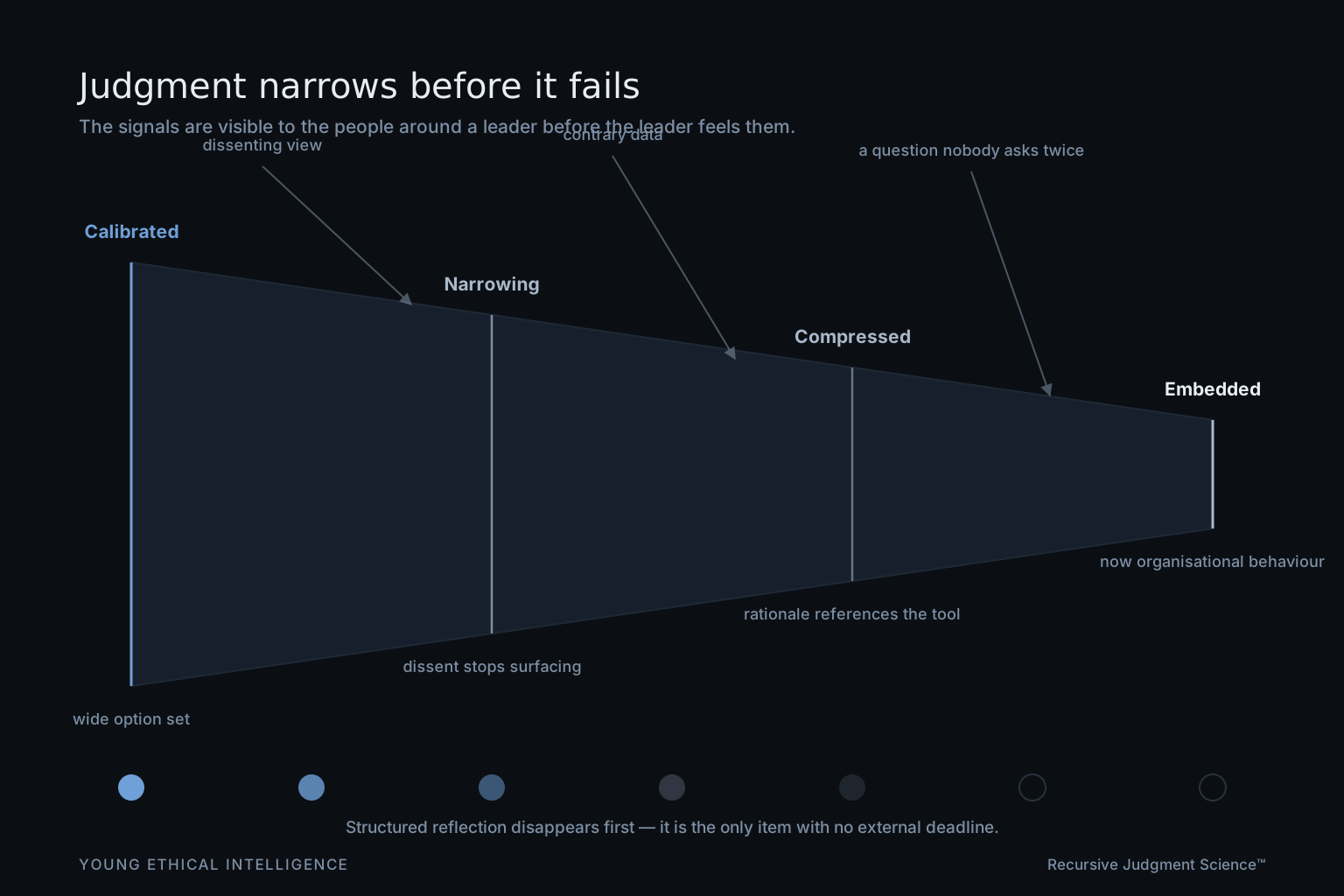
Picture a senior executive who, eighteen months ago, was known for pushing back hard in the boardroom. She asked uncomfortable questions, sought input from outside her immediate circle, and regularly reversed course when new evidence demanded it. Today, she still appears decisive. Her calendar is full, her responses are prompt, and her confidence reads as leadership. But her decisions have quietly narrowed. She routes fewer problems through rigorous debate. She agrees more quickly. She has stopped sitting with ambiguity long enough to let it yield useful information. No performance review has flagged it. No one has named it. The organization has simply adapted around it, and that adaptation is itself a warning sign. What you are reading is an early portrait of leadership judgment erosion in a senior executive, and it rarely announces itself any louder than this.
This is how discernment degrades in senior leaders: not dramatically, but incrementally. Leadership judgment erosion is a gradual process, shaped by habitual AI delegation, chronic decision overload, and the slow disappearance of reflective practice. By the time it surfaces as a visible institutional failure, it has usually been operating undetected for months or years. What follows is a diagnostic framework drawn from behavioral neuroscience, AI overreliance research, and applied practice in high-stakes leadership contexts. The goal is recognition before compounding, not recovery after collapse.
The mechanics of how leadership judgment erosion actually begins
Leadership judgment does not collapse. It contracts, through a narrowing of decision categories, a decreased tolerance for ambiguity, and a gradual reduction in the cognitive effort leaders invest in interpretive work. When a leader habitually delegates pattern recognition, scenario analysis, or interpretive framing to AI systems or subordinate advisors, the capacity that once performed those functions is exercised less often. The erosion does not begin with bad decisions. It begins with fewer decisions that require genuine mental effort. Delegation is not inherently problematic; strategic delegation preserves judgment by focusing it on the decisions that most require it. The problem emerges when delegation becomes habitual rather than intentional, when the leader outsources not just execution but the act of making sense of a situation.
Structural fatigue accelerates the process in ways that are easy to miss because they do not look like burnout. Chronic high-frequency decision load, not acute crisis pressure, is what degrades discernment over time. Sustained decision volume saturates working memory and prefrontal executive systems, reducing a leader's capacity to hold competing options in mind, compare them, and tolerate unresolved complexity. The result is a predictable behavioral shift: decisions become simpler, faster, and more familiar. Tolerance for ambiguity narrows. The leader begins to prefer definite answers over open-ended analysis, not because the situation demands it, but because the cognitive cost of sitting with uncertainty has quietly risen beyond what depleted resources can afford.
Each time a leader avoids a complex judgment call, accepts a simplified brief, or adopts an AI-generated framing without interrogating it, the threshold for what qualifies as "good enough" shifts slightly downward. This is the erosion loop, and it is self-reinforcing. The leader who skips a challenging review session today finds the next one easier to skip. The cycle is nearly invisible from the inside because each individual shortcut feels reasonable in the moment. The cumulative effect only becomes legible in retrospect, and usually only when someone outside the leader's immediate orbit names what has been accumulating.
What the research says about AI delegation and declining judgment accuracy
AI overreliance and leadership judgment erosion: evidence from the field
The empirical literature on AI overreliance is direct in ways that most executive advisory conversations are not. Research on algorithm appreciation and AI overreliance shows that people may prefer algorithmic advice even when confidence in that advice is not warranted; the effect varies by task and context. The mechanism is trust: AI creates the appearance of a structured process, and leaders conflate process structure with decision quality. A separate experiment on AI-guided classification found that participants with more positive attitudes toward AI showed poorer discriminability and reduced task performance when AI guidance was present. In plain terms, trusting AI more was associated with thinking less accurately.
The critical distinction for senior leaders is the difference between AI augmentation and AI substitution. Augmentation means the leader uses AI output as one input among many, exercises interpretive authority over the conclusion, and can articulate why they accepted or rejected the AI's framing. Substitution means the AI's framing becomes the leader's framing, adopted without interrogation. Most leaders are convinced they are doing the former while gradually sliding into the latter. The slide is not conscious; it is structural. When AI recommendations arrive with apparent confidence and algorithmic authority, the cognitive path of least resistance is acceptance.
For an analyst, reduced independent analysis is a task-performance issue. For a senior executive, it is a judgment-identity issue with institutional consequences. When a leader can no longer clearly articulate the reasoning behind a decision without referencing what the AI suggested, the organization loses its most important accountability anchor. Decision provenance, the clear chain of reasoning from evidence to conclusion to accountable individual, breaks down. And once it breaks down, governance bodies lose the ability to assess whether sound judgment is present or whether it has been quietly outsourced.
Early signs of leadership judgment erosion that appear before visible failures
The behavioral signals that precede visible organizational failures are observable by those around the leader before they are felt by the leader. Decisions become rushed or consistently deferred. The leader's tolerance for dissent narrows; probing questions are replaced by early consensus. Feedback is met with justification rather than curiosity. Ambiguous or complex problems are avoided in favor of familiar terrain. These are not occasional lapses under pressure. They are pattern shifts from a prior baseline, and that change from baseline is the critical diagnostic signal.
Individual deterioration of leadership judgment radiates outward into organizational behavior. Teams begin to hide problems from leaders who respond slowly or unpredictably, which means the leader receives a progressively cleaner, less accurate picture of institutional reality. Escalation frequency rises. Decision velocity slows. And, in a particularly telling dynamic, the leader's confidence in decisions often increases as their quality decreases, because the remaining decisions are simpler and more familiar. In practice, prolonged decision delays can coincide with talent loss, client contraction, and material revenue exposure. The cost of unrecognized leadership judgment erosion is not merely abstract, but specific outcomes require case-level evidence.
Stakeholders and governance bodies often sense declining judgment quality before they can name it. Trust erodes through accumulated micro-signals: a leader who used to push back now agrees too quickly; a leader who once sought diverse input now routes decisions through a narrower circle; a leader who once demonstrated intellectual discomfort with easy answers now accepts them without pause. These micro-signals accumulate into a trust gap that is rarely articulated directly but shapes how the board, direct reports, and key clients engage with the leader's authority.
Why reflective practice disappears first and what its absence costs
Structured reflection is not journaling or mindfulness. It is the deliberate, often uncomfortable cognitive process by which a leader compares current decisions to past patterns, surfaces implicit assumptions, and recalibrates their internal models of how the world works. It is the mechanism through which judgment stays calibrated over time. And it is almost always the first behavior to disappear under organizational pressure, not because leaders decide to stop, but because it is the least visible, carries no immediate accountability, and is rarely embedded in any organizational rhythm that would make its absence noticeable.
When structured reflection disappears, the leader loses the process by which automatic responses get compared against evidence. Without that comparison, anchoring, confirmation bias, and groupthink gain significant ground. The leader who is no longer examining their own decision patterns becomes more susceptible to accepting the first plausible framing of a situation, agreeing with the most recent confident voice in the room, and unconsciously selecting evidence that confirms existing beliefs. This does not produce dramatic errors in the short term. It produces a slow narrowing of the decision space until the options available are all suboptimal, and the leader has no internal mechanism to recognize that the narrowing has occurred.
Post-decision reviews and structured post-mortems are among the most evidence-supported interventions for reversing this trajectory. Research on leadership development programs combining goal setting with data-informed feedback (see Smither et al., 2003, for foundational work in this area) has shown reductions in the gap between leaders' self-assessments and their employees' behavioral assessments. That is a measurable reduction in the self-perception distortion that allows erosion to go unrecognized. The intervention works because it reintroduces the comparison function that reflective practice normally provides: the leader is shown evidence of how their decisions are actually landing, not how they feel from the inside.
How URIEL surfaces erosion before it becomes institutional risk
Many AI platforms marketed to senior executives are primarily answer-generation systems. They synthesize data, surface options, and produce recommendations, operating on the assumption that faster answers produce better decisions. URIEL is available. The platform from Young Ethical Intelligence is designed around a different premise: the problem is not that leaders need faster answers; it is that leaders need clearer visibility into the internal patterns shaping the answers they are already reaching. Rather than generating outputs for leaders to accept or reject, URIEL is applied Decision Intelligence Infrastructure designed to illuminate those patterns and return that awareness to the individual accountable for the outcome.
The platform's architecture is grounded in the Recursive Human Systems Model, a proprietary behavioral framework that maps Thought, Emotion, Neurochemistry, Behavior, Consequence, and Belief as an interconnected closed-loop system rather than a linear decision process. In practical terms, this orientation is intended to help URIEL surface patterns associated with possible judgment decline: narrowing decision categories, increasing acceptance of AI-generated framing without interrogation, declining engagement with disconfirming evidence, and reduced tolerance for ambiguous inputs. The goal is to make these patterns visible to the leader early, when leaders and governance bodies still have more room to examine and interrupt them.
The governance dimension matters as much as the individual dimension. When a leader's judgment patterns are documented and traceable over time, organizations gain an accountability anchor that currently does not exist in most executive governance structures. Decision provenance, knowing where a decision came from, who shaped it, and what reasoning supported it, can provide governance bodies with meaningful visibility into decision quality, much as financial audits provide structured transparency into financial integrity (though robust implementation and independent review are essential for any such system to function at that level). This is not surveillance. It is the institutional infrastructure that makes leadership accountability substantive rather than ceremonial.
What a practical recovery looks like, and how to know it's working
Starting with a structured diagnostic
The first step is an honest diagnostic, not a program. Assess the current state of decision quality before designing an intervention. This means reviewing decision velocity and reversal rates over the past twelve to eighteen months. It also means soliciting structured 360-degree feedback focused on specific observable behaviors rather than general impressions, and using a Situational Judgment Test to establish a performance baseline. The point is not self-criticism, it is building the evidence base that makes recovery directional rather than aspirational.
Rebuilding the habits that erosion removes
The intervention itself involves reinstating structured decision reviews, reintroducing deliberate friction into AI-assisted decisions, and rebuilding the habit of seeking disconfirming input before concluding. Calendar-embedded reflection practices with explicit accountability, not optional reflection time, but scheduled review with a documented output, are central to this work. Consultative habits that were gradually replaced by faster, narrower routing need to be deliberately rebuilt. None of this is comfortable, and that discomfort is an accurate signal that the cognitive muscle is being used again.
Recovery is confirmed by specific metrics, not by effort or intention. The indicators that matter are decision reversal frequency, decision cycle time, escalation frequency, and whether teams can accurately recall and act on leadership priorities without repeated clarification. These metrics distinguish genuine judgment recovery from behavioral performance on display. Leadership judgment erosion may be reversible. Leaders can use structured, evidence-informed recovery practices to test whether the gap between self-assessment and institutional impact is closing. But the recovery must be treated with the same rigor as the diagnosis. A commitment to a program without a measurement architecture is not recovery; it is activity. Begin with the diagnostic. The rest follows from what the evidence shows.
The contraction that compounds quietly
Leadership judgment erosion is not a dramatic collapse visible in a single quarter's results. It is a quiet contraction, shaped by habitual AI delegation, chronic decision overload, and the gradual elimination of the reflective practice that keeps judgment calibrated. The early warning signs exist, are observable by those around the leader before they are felt by the leader, and are recoverable when recognized before they become embedded in organizational behavior. The window for low-cost intervention is real, but it is not indefinitely open.
Young Ethical Intelligence is developing URIEL for this category of challenge: helping senior executives, governance bodies, and high-consequence professionals make the internal work of judgment restoration auditable, structured, and durable. The methodology draws on behavioral-neuroscience literature and Dr. D. Ivan Young’s extensive practice-based work with leaders who carry decisions whose consequences extend beyond a single reporting cycle. If what you have read here describes patterns you recognize, in yourself or in the leadership structures you are accountable for, the right next step is a diagnostic, not a program enrollment. Start with an honest assessment of where judgment currently stands. Everything else becomes clear from there.
Continue the work
- Review the Recursive Human Systems Model™
- Learn about Dr. D. Ivan Young
- Visit URIEL Ethical Intelligence
- Request a strategic conversation
Research sources
- Deskilling dilemma: brain over automation
- Deskilling in ophthalmology: is the inevitable controllable?
- Automation-induced complacency potential: development and validation of a new scale
- The kryptonite of smart decisions? Overconfidence (Association for Psychological Science)
- What was I thinking? Kahneman explains how intuition leads us astray (Association for Psychological Science)
- Assessing leadership decision-making styles: the Leadership Judgement Indicator
- Can you really measure whether a leader has good judgment?
Terms covered: Leadership judgment erosion, Decision provenance, Structured reflection, Recursive Human Systems Model™. These are defined and attributed in the FAQ.